

The ability to turn water into wine is not limited to the miracles of Jesus of Nazareth in the Bible. Although it may seem unusual, a team from Kyoto University turned to an everyday phenomenon to reveal the role of yeast and the changes that occur during the drying of grapes. Their work links ancient practices to modern methods of genetic analysis, describing how different environments favour the presence of microorganisms capable of transforming sugars in the presence of water.
How did Japanese researchers manage to turn water into wine?
The research we will reveal below describes in detail how drying alters the microbial ecosystem of grapes, transforming them into a reservoir of specialised yeasts. The article, published in the journal Nature, starts from a common observation: when raisins are immersed in water, the liquid becomes cloudy after a few days and begins to give off an alcoholic smell.
While fresh grapes contain a diverse mix of fungi and bacteria, they contain almost no Saccharomyces cerevisiae, traditionally associated with wine fermentation. However, sun drying acts as a natural filter, allowing yeasts that are resistant to water shortage and intense osmotic conditions to survive.
The action begins when the raisins are rehydrated. Water dissolves the concentrated sugar in the pulp and creates an environment that immediately activates the yeasts. Within a few days, their population reaches a level that allows them to produce ethanol in quantities comparable to those found in mild wine.
These microorganisms gradually replace other species, reducing diversity, until only the most alcohol-tolerant remain.
A simple experiment to understand how natural fermentation works
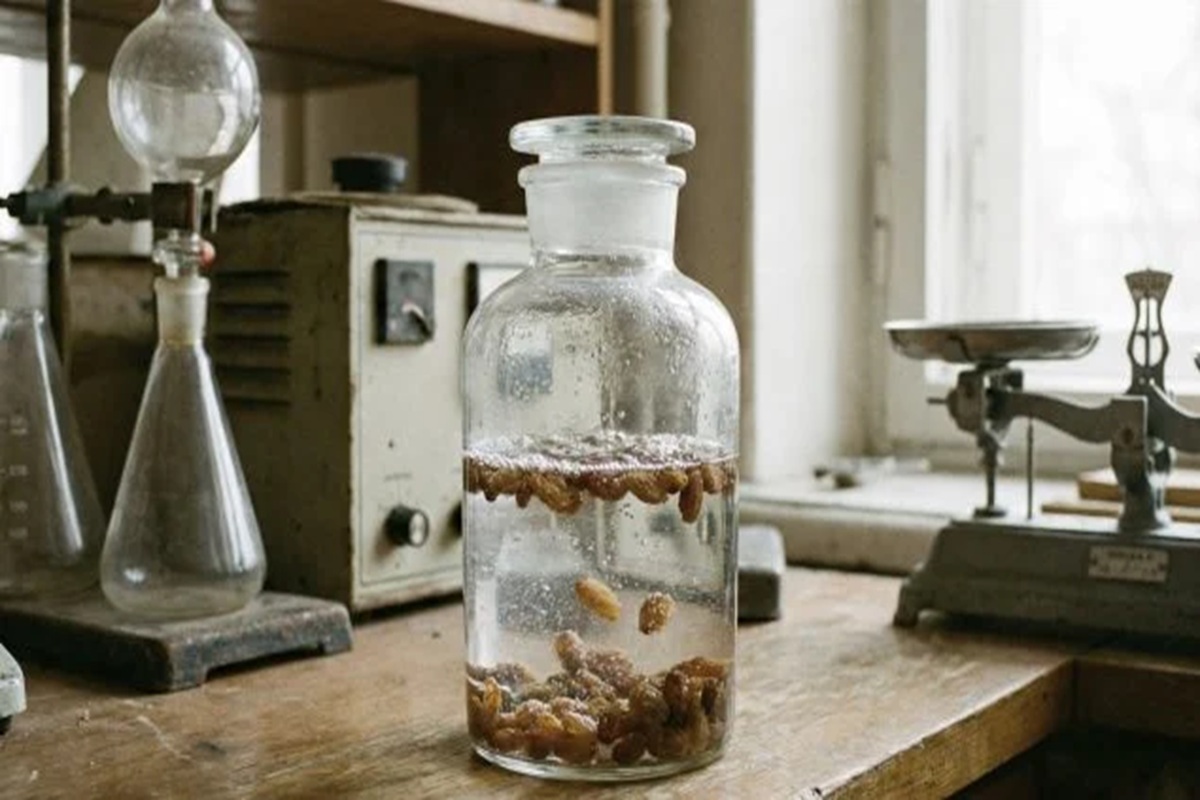
The protocol applied by the Japanese team to turn water into wine consisted of placing raisins in bottles with sterilised water, which were stored at a temperature of 25 °C. From the second day onwards, the samples showed bubbles and a change in the density of the liquid. In less than a week, fermentation reached significant levels, with more than 100 million yeast cells per millilitre and virtually no bacteria present. The analyses showed that sun-dried raisins generated much more active fermentation than those obtained in an incubator or with a combination of both methods. In some cases, the final ethanol concentration was around 90 g/l.
The study also shows that different varieties of raisins behave differently: the sultana variety, very common in supermarkets, showed good results, with the exception of some batches where the drying method was uncertain. To understand where the yeast came from, the researchers produced several batches of raisins themselves. Only those exposed to direct sunlight developed a microbiological environment capable of effectively fermenting water. The hypothesis points to insects, dust, and other environmental factors as the cause of the transfer of special yeasts to the grape skins during traditional drying.
The ancient practice of turning water into wine
The Kyoto University analysis coincides with historical references to the preparation of fermented beverages from raisins. Ancient texts describe passum, a sweet wine produced in various regions of the Mediterranean. The new scientific approach demonstrates that this type of beverage could be obtained without microscopic control, using the microbiological load of raisins and allowing fermentation to take its course. Sun drying is a key element, as it transforms the grapes into a stable medium for yeasts capable of producing alcohol even out of season. This explains the production of beverages in regions where fresh fruit did not keep well or where the climate made prolonged storage difficult.
Ideal conditions for raisin fermentation
The research identifies the parameters that contribute to the transformation of water with raisins into a liquid with ethanol content. Among them are:
- Raisin content: 25% to 33% by weight.
- Temperature: 25 °C to 30 °C.
- Duration: 8 to 14 days.
Changes in these factors affect the effectiveness of the process. At low temperatures, fermentation slows down, and in warmer conditions, undesirable fungi appear. In addition, not all raisins available on the market are suitable: many of them have a greasy skin that prevents hydration and yeast activity. Although the procedure can be reproduced at home, the authors emphasise that the result should not be consumed without hygienic control. Their goal is to understand the dynamics of microorganisms and study possible applications in the food industry, not to offer a recipe for everyday use.