
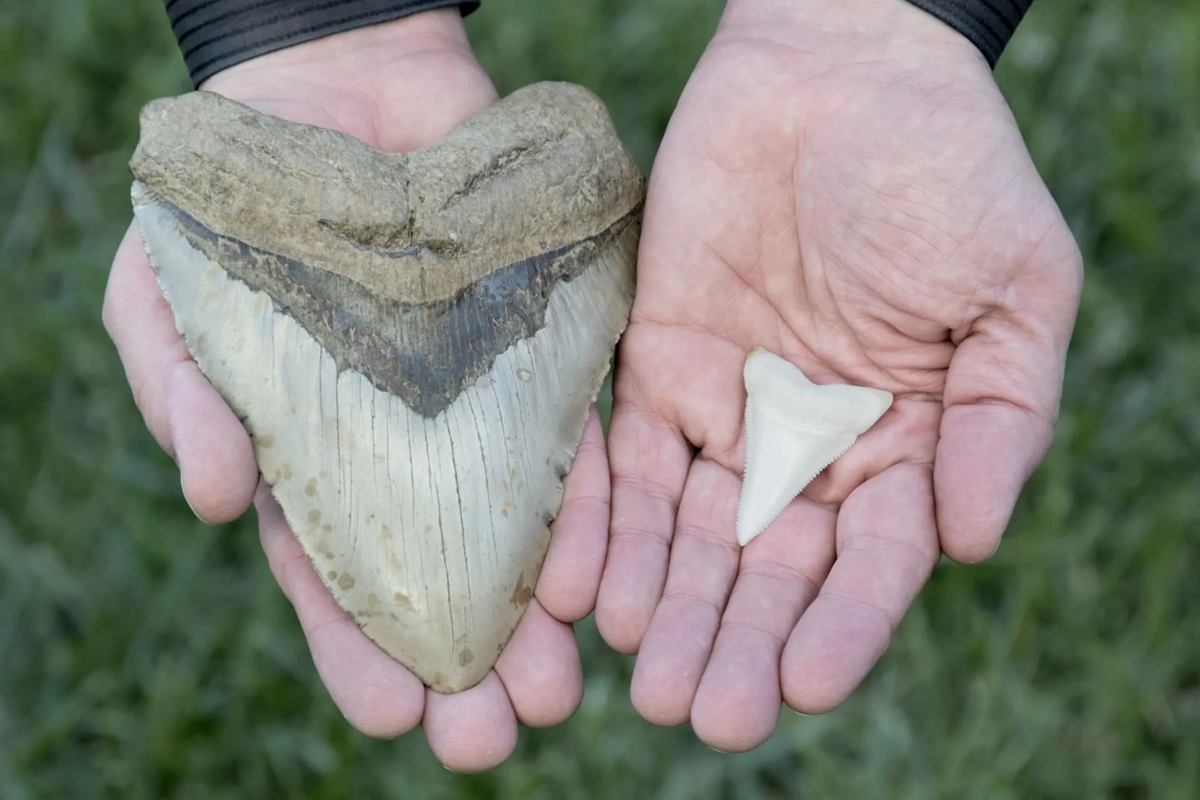

Until now, it was believed that this predator was marine. However, the archaeological discovery was made 2,000 kilometres from the ocean. A 66-million-year-old fossilised tooth found in North Dakota is causing scientists to rethink the traditional view of prehistoric rivers. The discovery proves that these ecosystems were home not only to diverse fauna, but also to giant predators, the size of a city bus, capable of dominating the food chain.
The fossil was found during excavations in the Hell Creek Formation, one of the world’s most important sites for studying the final moments of the Cretaceous period. The discovery was made near the remains of Tyrannosaurus rex and crocodiles, which already indicated a complex and biologically active river environment in the moments leading up to mass extinction. Analyses identified the tooth as belonging to a mosasaurid from the Prognathodontini group, reptiles known until now as large marine predators. What is surprising is that the site is almost 2,000 kilometres from the ocean, even at a time when sea levels were higher than today.
Marine predator adapted to freshwater

To discover the origin of the fossil, the researchers conducted a detailed isotopic study of the tooth enamel. The ratio of oxygen and strontium did not correspond to marine values, but was characteristic of freshwater environments, indicating that the animal lived stably in the river system and had not been brought from the sea. The study, which will be published in the scientific journal BMC Zoology shortly, links this adaptation to a period of profound geological change. The ancient western inland sea route, which divided North America, lost its connection to the oceans and gradually transformed into a network of rivers and brackish zones.
Far from becoming extinct with the disappearance of the inland sea, some mosasaurs demonstrated a remarkable ability to adapt. As explained by researcher Melanie Düring, this process is not exceptional, as ‘the transformation into a freshwater species is a very complex adaptation,’ while the return to freshwater is physiologically easier.
River giants at the end of the Cretaceous period
The estimated dimensions of the specimen, about 11 metres long, make it the largest predator documented in the river environment of the time. Carbon isotope analysis also indicates an unusual diet, consistent with the consumption of herbivorous dinosaurs, possibly carried by the currents. This discovery changes our perception of continental ecosystems at the end of the Cretaceous period. Rivers were not secondary spaces, but scenarios dominated by true prehistoric monsters, capable of rivalling in size and strength the largest marine predators known to science.